Event-driven microservices in healthcare can help organizations build resilient, scalable platforms for workflows that span providers, payers, clinical systems, pharmacies, and members. This concise guide explains how Kafka, FHIR, transactional outbox, idempotent consumers, workflow orchestration, and observability can work together to support reliable healthcare workflows. A concise guide to Kafka, FHIR, transactional outbox, idempotent consumers, and observable healthcare workflows.
By Reshma Thakkallapelly | 8-10 minute read
Healthcare workflows span providers, payers, clinical systems, pharmacies, and members. This concise playbook shows how to use a late-2024 technology stack to publish healthcare business events reliably, coordinate long-running processes, protect sensitive data, and operate the platform with measurable resilience.
Technology baseline: The technology versions in this article intentionally reflect a late-2024 reference architecture. The design is a reference architecture and is not a legal or regulatory compliance certification.
Event-Driven Microservices in Healthcare
Healthcare systems rarely operate in isolation.
A provider submits a prior-authorization request. A payer verifies eligibility and benefits. A clinical-rules service evaluates medical criteria. The result may require documents, human review, notifications, analytics, and a complete audit trail. In a traditional design, these steps often become a long chain of synchronous calls.
That chain works until one downstream system is slow or unavailable. A notification failure can block the original request, latency grows with every dependency, and adding a new consumer often requires changing the service that accepted the request.
Event-driven microservices offer a different model: record the business fact once, publish it reliably, and let independent services react at their own pace. The approach is powerful, but only when contracts, security, duplicate delivery, ordering, replay, and operations are treated as first-class design concerns.
Event-driven does not mean event-only. Use synchronous APIs for immediate commands and queries; use events for propagation, long-running workflows, and decoupled reactions.
Prior Authorization as a Healthcare Workflow
Prior authorization is a useful reference workflow because it combines an immediate user action with asynchronous work. The provider needs fast confirmation that the request was accepted, but eligibility checks, benefit evaluation, clinical review, document collection, and notifications may continue for minutes or days.
A resilient platform should therefore:
- Return a tracking ID rather than wait for the entire workflow.
- Let each domain service own its business rules and operational data.
- Let the workflow coordinator own timers and process state, not every domain rule.
- Allow audit, analytics, and notification services to consume the same durable business facts independently.
A Late-2024 Reference Stack
The exact products can vary, but the following combination was a practical baseline for a Java-centered healthcare platform in late 2024.
| Area | Late-2024 baseline |
|---|---|
| Application | Java 21, Spring Boot 3.2.x, Spring for Apache Kafka |
| Messaging and contracts | Apache Kafka 3.7/3.8, CloudEvents 1.0.x, AsyncAPI 3.0 |
| Reliable publication | PostgreSQL 15/16 transactional outbox with Debezium 2.x |
| Workflow and interoperability | Temporal 1.x or Camunda 8.x; FHIR R4, HL7 v2, X12, and NCPDP |
| Platform and delivery | Kubernetes 1.29/1.30, Helm 3, GitOps-based delivery |
| Security and observability | OAuth/OIDC, mTLS, KMS/Vault, RBAC/ABAC, OpenTelemetry, Prometheus, and Grafana |
The same architecture can be implemented with .NET 8, Go, managed cloud messaging, or other workflow engines. The durable patterns matter more than a single vendor choice.
Reference Architecture
The architecture keeps interoperability concerns at the edge, business ownership inside domain services, reliable publication within the transaction boundary, and asynchronous fan-out on the event platform.
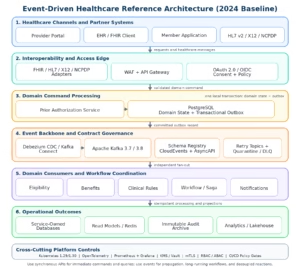
The flow has six clear boundaries:
- Channels and partner systems submit FHIR, HL7, X12, NCPDP, portal, or application requests.
- The access edge authenticates callers, enforces consent and policy, validates payloads, and creates trace context.
- A domain service commits business state and an outbox record in one local PostgreSQL transaction.
- Debezium publishes committed outbox records to Kafka; a schema registry and AsyncAPI contracts govern compatibility.
- Eligibility, benefits, clinical rules, workflow, notifications, audit, and analytics consume independently.
- Kubernetes, OpenTelemetry, encryption, workload identity, and policy controls apply across the platform.
FHIR is most valuable at interoperability boundaries. Internal services should not be forced to store every domain concept as a complete FHIR resource. A service can accept or expose FHIR while maintaining a focused domain model and publishing a minimal business event.
How a Request Moves Through the Platform
A practical prior-authorization path looks like this:
- The provider submits a request through a portal or FHIR API.
- The edge validates identity, authorization, consent, required fields, and request size.
- The prior-authorization service saves the request and the
PriorAuthorizationSubmitted
outbox event atomically. - The API returns
HTTP 202 Acceptedwith a tracking ID and status URL. - Debezium captures the committed outbox row and publishes it to a domain-owned Kafka topic.
- Eligibility, benefits, and clinical-rules services evaluate the request and publish their own outcome events.
- A workflow engine correlates the outcomes, manages deadlines and human review, and then publishes
Approved,
Denied, or
Pended.
A Minimal Event Contract
CloudEvents provides a consistent envelope for event identity, source, type, subject, time, and schema. The payload should contain only what legitimate consumers need.
{
  "specversion": "1.0",
  "id": "9fb1438c-2ff2-4b67-a1a9-7ad7833db625",
  "source": "urn:service:prior-authorization",
  "type": "com.health.pa.submitted.v1",
  "subject": "prior-authorization/pa_01J8Y7F2M6",
  "time": "2024-10-15T14:22:31Z",
  "correlationid": "corr_01J8Y7EJH8",
  "causationid": "cmd_01J8Y7EK31",
  "data": {
    "priorAuthorizationId": "pa_01J8Y7F2M6",
    "memberToken": "mbr_tok_A71D92",
    "serviceCode": "coded-value",
    "sourceReference": "FHIR-R4/ServiceRequest/sr_74512/_history/3"
  }
}
The contract intentionally avoids names, addresses, complete clinical histories, access tokens, and full FHIR bundles. An authorized consumer can retrieve additional detail through a protected API when its business purpose requires it.
Seven Rules That Make the Design Production-Ready
1. Keep synchronous and asynchronous boundaries explicit
Use a synchronous request when the caller needs immediate validation or a current answer. Use an event when downstream work can happen independently. Do not convert every query or local state change into messaging simply because Kafka is available.
2. Eliminate the dual-write failure with a transactional outbox
Updating a database and then publishing to Kafka are two separate actions. A crash between them can leave state without an event or an event without valid state. Write the domain record and outbox row in the same local transaction, then let change-data capture publish only committed rows.
3. Assume at-least-once delivery and make consumers idempotent
A consumer may update its database and crash before committing the Kafka offset. The event will be delivered again. Use processed-event tables, unique business keys, guarded state transitions, conditional updates, and external idempotency keys so that duplicates do not repeat the business effect.
4. Partition by the entity that requires order
Kafka preserves order within a partition, not globally. Use
priorAuthorizationId,
claimId, or
prescriptionId
as the key when lifecycle ordering matters. Avoid event IDs as keys because each event is unique and related events will be scattered across partitions.
5. Treat event contracts as products
Every event needs an owner, a stable business meaning, an AsyncAPI definition, a payload schema, classification, retention policy, and compatibility rules. Add optional fields for compatible change; use a new major version when semantics change. Test new consumers against retained historical events.
6. Minimize PHI and enforce least privilege
No broker or cloud service is automatically HIPAA compliant. Protect producers, consumers, connectors, schema registries, administration tools, logs, backups, and disaster-recovery clusters. Use tokenized identifiers, TLS, workload identity, topic ACLs, encryption at rest, centralized key management, controlled retention, and separate audit records.
Application logs should not print entire event payloads. Log event IDs, schema versions, service names, timing, and sanitized error codes. Audit events should separately capture who or what accessed or changed sensitive resources, under which authority, and with what outcome.
7. Design observability, workflow, reconciliation, and replay together
Propagate traceparent, event ID, correlation ID, causation ID, aggregate ID, workflow ID, producer version, schema version, and business occurrence time. Monitor not only broker health and consumer lag, but also submission-to-decision time, pending-document age, workflow timeouts, quarantine age, and reconciliation differences.
Replay must distinguish projection rebuilding, missed-event recovery, and business re-evaluation. A controlled replay uses a bounded event range, an approved consumer group, explicit side-effect suppression, idempotency checks, and before-and-after reconciliation.
Retries, Quarantine, and Recovery
Transient failures such as timeouts, temporary database outages, or rate limiting can be retried with bounded exponential backoff and jitter. Permanent failures such as an unknown event type, invalid schema, impossible state transition, or policy violation should move to a quarantine path.
A dead-letter topic is not a disposal bin. It is an operational work queue with an owner, age-based alerts, a reason code, repair instructions, approval for replay, and an audit trail. Reconciliation jobs should compare authoritative state with downstream outcomes so that missing or inconsistent processing can be detected even when no infrastructure alert fires.
Common Mistakes and Better Alternatives
| Anti-pattern | Better approach |
|---|---|
| Shared operational database | Give each service private write ownership; integrate through APIs, events, or governed projections. |
| Raw CDC as a business contract | Use CDC to transport intentional outbox events, not expose table mutations to domain consumers. |
| Full FHIR bundle in every event | Publish a minimal domain fact plus a protected resource reference. |
| Assuming global order | Define the aggregate that needs order and use a consistent partition key. |
| Infinite retries | Classify errors, bound retries, quarantine permanent failures, and alert the owner. |
| Universal exactly-once claims | Combine Kafka guarantees with business idempotency for databases, APIs, and notifications. |
| Unsafe replay | Separate projection rebuilds from side-effecting business actions and reconcile every run. |
A Practical Adoption Roadmap
- Choose one bounded workflow with clear ownership, integration pain, multiple consumers, and measurable outcomes.
- Define guardrails before production: event envelope, topic naming, schema compatibility, data classification, ACLs, retries, retention, tracing, and replay approval.
- Build one complete vertical slice from API command through outbox, CDC, Kafka, idempotent consumer, workflow outcome, telemetry, alerting, and reconciliation.
- Failure-test duplicates, out-of-order events, connector downtime, poison messages, slow consumers, schema changes, backup restore, and replay before scaling the pattern.
- Turn proven patterns into reusable templates, libraries, dashboards, runbooks, and production-readiness checks for other domain teams.
Production Readiness Questions
- Does the event describe a stable, past-tense business fact with an accountable owner?
- Are business state and event publication protected by one local transaction?
- Can every consumer process a duplicate safely?
- Is the partition key aligned to the entity that requires ordering?
- Is the payload minimized, classified, encrypted, and access-controlled?
- Are retries bounded and quarantine records actively owned?
- Can one workflow be traced from command to final business outcome?
- Can recovery and replay occur without repeating unsafe side effects?
Final Thoughts
Event-driven microservices can isolate failures, support independent scaling, add consumers without changing producers, and make long-running healthcare processes easier to evolve. Kafka is only one part of that outcome.
The platform becomes dependable when business boundaries are clear, events are versioned, publication is atomic, consumers are idempotent, PHI is minimized, workflows are observable, and reconciliation can prove that the intended outcome occurred.
Commit the business fact once, publish it reliably, let independent services react, and make every outcome observable, secure, auditable, and recoverable.
Official References
Spring Boot 3.2.3 Reference Documentation
Apache Kafka 3.8.0 Release Announcement
Kubernetes v1.30 Release Announcement
HL7 FHIR R4 RESTful API
CloudEvents Specification and Project
AsyncAPI Specification 3.0.0
Debezium Outbox Event Router
OpenTelemetry Documentation
HIPAA Security Rule Technical Safeguards – 45 CFR 164.312